$200 more a month is worth four years of retirement.
Planning does not predict the future: it shows what your current pace produces if nothing changes, and by how much one move shifts the date.
Yoseri is not open yet outside Canada.
This page describes the product as it works in Canada. The pension plans, the tax shelters and the connected banks here are Canadian: they do not transpose. Where you are, it would rather be the local public plan, with the local tax shelters as tax shelters and your tax administration opposite.
We do not claim to know those rules today — connecting them is work, not a translation. Tell us where you are: the order in which markets open is decided there.
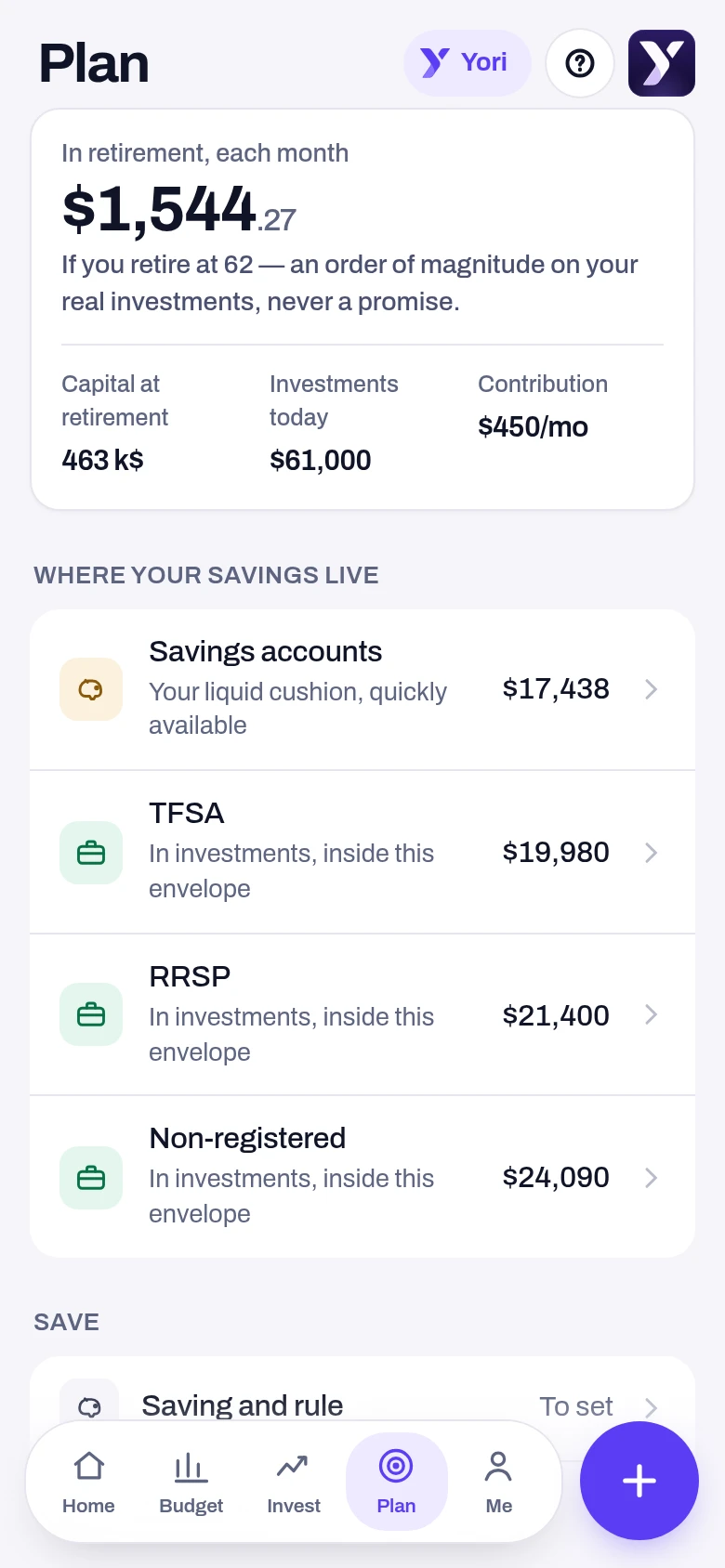
Your current pace takes you to 2056. That is not fate, it is arithmetic.
Three projections on the same data: what you do today, $200 more a month, and the card debt paid off first. All three use the same assumptions — only your move changes.
Your cushion covers 2.4 months of spending. Getting to three months takes $1,680 more, or seven months at your current pace — and pushes the goal back by only four months.
A projection without its assumptions is a made-up number.
They are written out, not hidden in the code. Change one, and the three scenarios recalculate in front of you.
See where your current pace leads.
Planning predicts nothing: it extends your real amounts and shows the month that pinches.
The demo runs on test data. No banking credentials are requested.
Further reading on this.
Yoseri’s publication unpacks these mechanisms with the maths shown, using worked figures you can redo by hand.
FHSA or TFSA: the same $34,000 is not worth the same
Two accounts, one down payment. One hands back part of your tax straight away, the other does not. On a $34,000 goal, the gap runs into the thousands.
· 6 min The BreakdownThe order in which you empty your accounts is worth $64,800
Accumulating is half the work. Nobody looks at the other half until they get there — and between the best and the worst withdrawal order, the gap reaches $64,800 over thirty years.
· 6 min The BreakdownClaiming your pension at 60, 65 or 70: the calculation nobody makes
Deferring your public pension by five years takes it from $890 to $1,264 a month. The calculation is simple; what it hides is less so — it commits you to an assumption about your own longevity.
· 5 min The BreakdownTaking $10,000 out of an RRSP leaves you $6,000
The tax withheld at source is not the tax. It is a down payment — and the contribution room never comes back.
· 5 min The BreakdownTFSA or RRSP: at equal rates, the gap is zero dollars
It is not a question of product, it is a question of one number: your marginal rate today against the one you will have on withdrawal. On $5,000 over twenty-five years, it decides $2,146.
· 6 min The ShortTaking $5,000 out of your TFSA and putting it back the same year is not neutral
The room you free up by withdrawing does not come back right away. It comes back on 1 January — and that is the most common way to over-contribute without knowing.
· 2 min The GlossaryMarginal rate
The rate that hits your next dollar, not the ones before it. Crossing a federal bracket in 2026 moves your average rate by sixteen hundredths of a point — and leaves you 82.8% of your raise.
· 1 min The GlossaryCredit or deduction
$1,000 as a deduction and $1,000 as a credit are not worth the same — unless you are in the first bracket. Above it, the gap is exactly your marginal rate minus 14%.
· 1 min The BreakdownSelf-employed: in year two, you pay two years of tax
The year-two cash shock does not come from a bigger tax bill. It comes from the calendar: last year’s balance and this year’s instalments land in the same twelve months.
· 6 min