Two accounts. Not one shared login.
Run the couple’s money without merging your accounts. Shared expenses, pots, common net worth — each keeps a full Yoseri, and chooses what to show.
Yoseri is not open yet outside Canada.
This page describes the product as it works in Canada. The pension plans, the tax shelters and the connected banks here are Canadian: they do not transpose. Where you are, it would rather be the local public plan, with the local tax shelters as tax shelters and your tax administration opposite.
We do not claim to know those rules today — connecting them is work, not a translation. Tell us where you are: the order in which markets open is decided there.
cle | The worked example’s 62/38 key, computed on both members’ declared incomes.
Free with manual entry, no banking credentials and no card. You see your first statement in four minutes.
Fifty-fifty is a default, not a law.
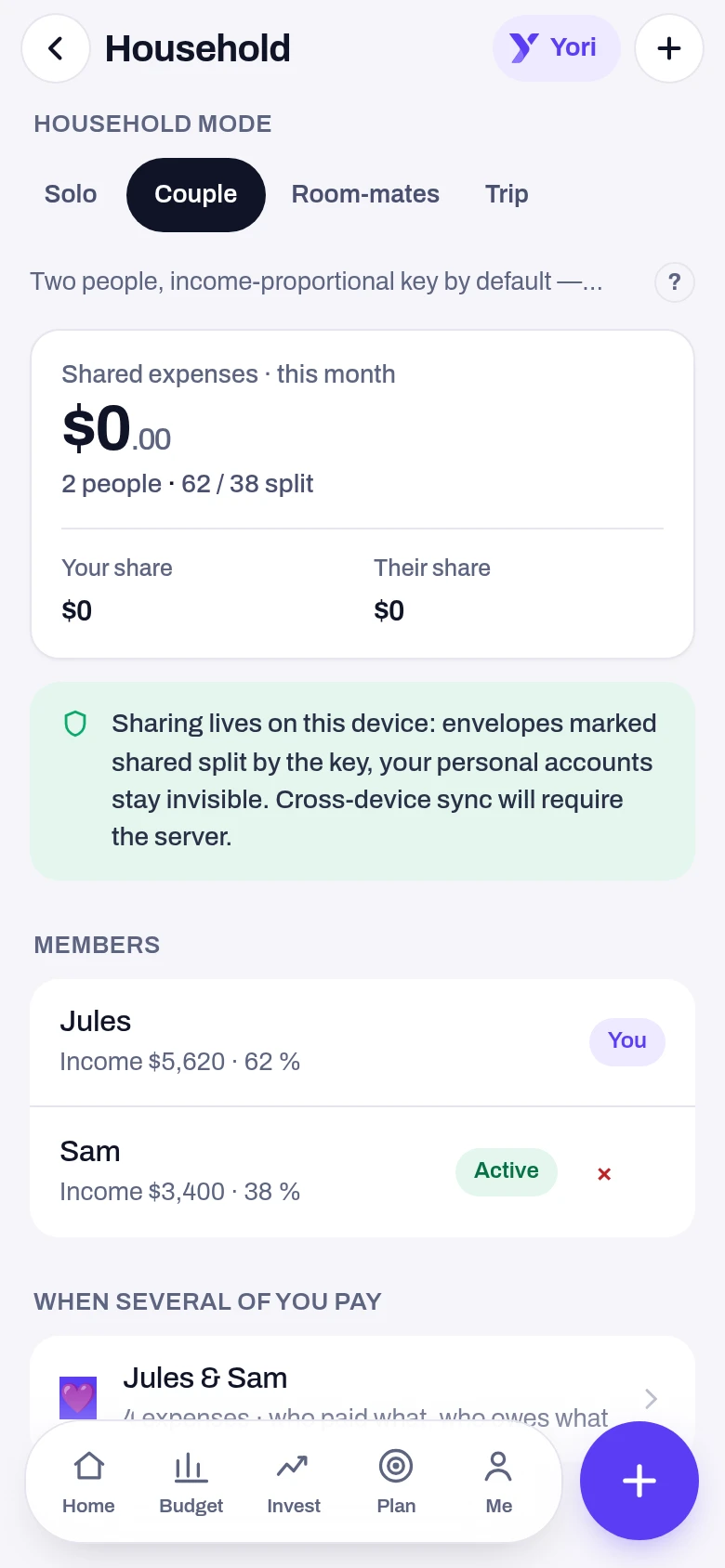
One of you earns $5,620 a month, the other $3,400. The key proposes 62/38 — proportional to income — and you change it if your household decides otherwise. The app imposes nothing; it computes, and shows the split next to its reason.
THE MODE
Couplealso: solo, flat-share, tripTHE KEY
62 / 38proportional to income, by defaultMEMBER 1
5 620 $declared income · 62%MEMBER 2
3 400 $declared income · 38%Mark an envelope “shared”, and the key does the rest.
Rent, groceries, the internet bill: the envelopes you mark as shared split along the key — your share and theirs, shown separately, month by month. Personal envelopes never enter the household, and neither do personal accounts.
- Four household modes: solo, couple, flat-share, trip — the key adapts
- Common pots and shared net worth on top of two intact budgets
- “What the others see” is a screen of its own: each member sets it
Common expenses · September
2 people · 62/38income $5,620 · 62%
your shareincome $3,400 · 38%
their shareTwo people, key proportional to income by default — never an imposed fifty-fifty. Envelopes marked shared split along the key; personal accounts stay invisible.
A couple is not a merger.
Each of you keeps a complete Yoseri — and each of you chooses what crosses into the household. A salary, a personal account, an old debt: visible only if its owner decides so, and the setting is a screen, not a buried toggle.
The invitation
By email, to their addressYou invite your partner by email. They create their own account, with their own password and their own two-factor — no shared login, ever, because a shared password protects no one.
Who pays
One bill or two, your choiceEither the one who invites pays for both — it costs the invited person nothing — or they pay a reduced rate on their own account. The amounts live on the pricing page only, so the two can never disagree.
If it ends
Two accounts remain two accountsDissolving the household closes the shared layer and stops its billing — each account keeps all of its own data. Nothing to export in a hurry, nothing hostage in the other’s account.
Today the sharing lives on each device: envelopes marked shared split along the key, personal accounts stay invisible. Synchronised sharing across devices requires the server — the app says so on the screen itself rather than letting you assume it.
What couples ask us before inviting.
What is shared, what stays private, and what happens to both accounts if the household dissolves.
Will my partner see everything I have?
Only what you decide to show. The household sees the shared envelopes, the common pots and whatever each member exposes on the “what the others see” screen. Personal accounts are invisible by default.
Why proportional to income rather than fifty-fifty?
Because a fifty-fifty split of a $1,450 rent weighs differently on a $5,620 income and a $3,400 one. Proportional is the default because it is the only key the app can derive from what you declared, rather than choosing for you — and it stays a default: change the key, and the app follows your rule.
Is Duo the same thing as a Share space?
No. Share is a tally — who paid, who owes, settle up. Duo is a household: two full accounts, an income-proportional key, common expenses and pots, shared net worth. The trip goes in Share; the life goes in Duo.
What happens to our data if we separate?
Dissolving the household closes the shared layer and stops its billing. Each account keeps everything that was its own — accounts, budget, history — because it always was a separate account, not half of a merged one.
Keep looking around
The lighter layer: a tally per group — the flat-share owes you $85 — and joining costs nothing.
See Share Savings and goalsCommon pots are goals too: a rule that is followed, a cushion, dated targets with their gap.
See savings PricingWho pays what in a Duo, the reduced rate, and every plan side by side — the amounts live there only.
See pricingTwo intact accounts. One honest household.
Invite by email, set the key once, and the household starts counting — without either of you giving up a password, a balance or a secret.
Each chooses what to show. Dissolving keeps both accounts whole. Yoseri moves no money.