The bank refused the authentication. What was sent: nothing.
All your wealth, in one place.
All you own, all you owe.
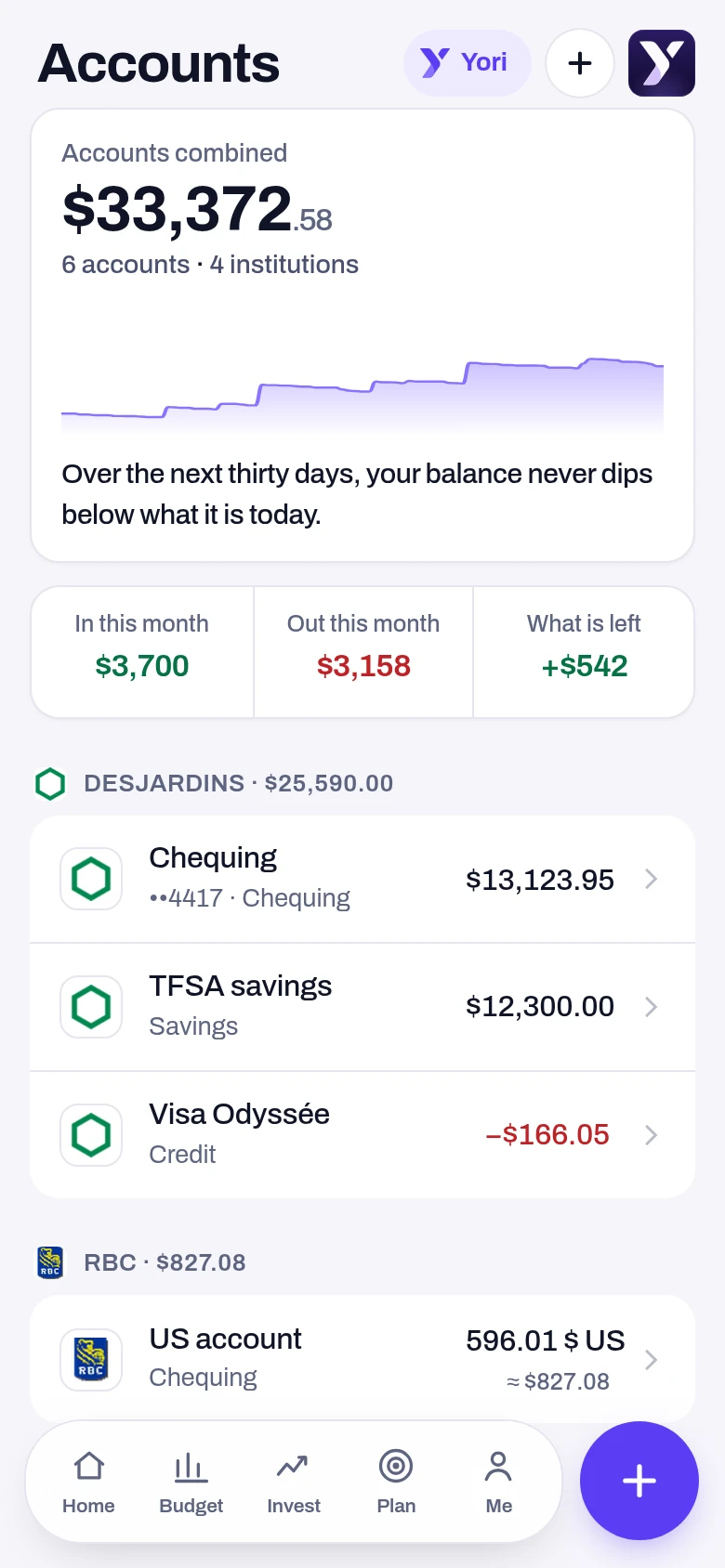
All your accounts in a single app. Banks, cards, cash, investments, assets — and your net worth, worked out as assets minus debt.
Read-only, always
129 institutions connected
Yoseri is not open yet outside Canada.
This page describes the product as it works in Canada. The pension plans, the tax shelters and the connected banks here are Canadian: they do not transpose. Where you are, it would rather be the local public plan, with the local tax shelters as tax shelters and your tax administration opposite.
We do not claim to know those rules today — connecting them is work, not a translation. Tell us where you are: the order in which markets open is decided there.
Net worth
$115,079.90 is what is left once everything you owe is subtracted.
It is not the sum of your accounts. It is $342,520 in assets minus $227,441 in debt — one figure, four lines on one side, four on the other.
Your property carries 81.7% of your assets. Your accounts, 3.6%.
That is the first thing the bar shows: what you own is highly concentrated, and very illiquid.
Four asset lines, four debts, no averages
View over 1 month, 6 months, 1 year or since the start
Every asset carries its valuation date, never a value without a source
Accounts gathered
$4,210.20 in the account. $4,050.20 you can actually spend.
The gap is $160 of pending transactions: purchases made and authorized, but not yet posted by the bank. Most apps show the book balance and let you discover the difference three days later.
Degraded mode
Two accounts read 12 minutes ago. A third frozen since 10:10 p.m. yesterday.
The status is carried by each account, not by the app. The total stays on screen — $12,480.20 — but it is labelled value possibly stale, with its last reliable value and its time.
Your cards
One point above 30%, and the calculation switches sides.
Three cards, $9,000 of limit, 14% used — and one card at 31%. The average says nothing: what weighs on your credit file is the utilization rate card by card. The ··0088 shows $1,240 of $4,000.
Your assets
$68,400 on the home, $5,800 on the vehicle.
Equity is the value minus what you owe on it. A financed asset has to appear in both places: the loan as a liability, the asset as an asset. Counting it on one side only distorts net worth.
Straight questions
Three questions people ask us before connecting an account.
The answers are short because the rules are.
Can Yoseri move money between my accounts?+
No. Access is read-only.
What do I see if my bank goes down?+
The last reliable value, with its time. When National Bank stopped answering at 10:10 p.m., the card stayed on screen at −$1,240.60, marked stale · since 10:10 p.m. yesterday, and the total carried the note “value possibly stale”.
Why does my car appear as both an asset and a liability?+
Because it is both. The vehicle is worth $14,200 as an asset, the $8,400 loan outstanding sits as a liability, and your real equity is $5,800.
All your accounts on a single screen.
Banks, cards, cash and investments, with the balance actually available.
The demo runs on test data. No banking credentials are asked for.
Yoseri News
Further reading on this.
Yoseri’s publication unpacks these mechanisms with the maths shown, using worked figures you can redo by hand.
The Investigation
Your car does not cost you $289 a month
The loan instalment is the visible half. Counting depreciation and interest, the real cost reaches $525 a month — of which $221 you never see go past.
· 7 min The GlossaryNet worth
What you own minus what you owe. The one figure that sums up a financial position in a single number — provided you count both sides.
· 1 min The GlossaryLiquidity
Something unexpected lands and your money is in the walls. Liquidity is how fast an asset becomes usable money again, without a loss.
· 1 min The ShortYour account fees come to exactly one dollar a day
$365.40 over twelve months, in four lines, three of which you have never read. None exceeds $17, and that is exactly why none gets noticed.
· 2 min The ShortYour money can only be in one place at a time
Repay, save or invest: every dollar sent somewhere is a dollar that is not somewhere else. That cost appears on no statement.
· 2 min The ShortYour statement says $200, the card charges on $933
Card interest is not charged on the balance printed on the statement. It is charged on the average daily balance — and the gap is a multiple, not a rounding.
· 2 min The ShortYou think you have 2.9 months ahead of you. You have 1.4.
$8,640 spread over three accounts looks like a cushion. Two of the three cannot be used — one is your working float, the other already has a destination.
· 2 min The ShortYour account says $1,420. You can spend $278.
Two figures live on the same screen: the book balance and the available balance. It is the second that decides whether your payment goes through — and it is almost never the one people look at.
· 2 min The GlossaryDisposable income
What is left once you have paid what you cannot not pay. It is the only figure that says whether a month is liveable — and it is on no statement.
· 1 min