What is left this month, worked out for real.
Track all your spending with Yoseri. Envelopes, calendar, recurring charges — and what is left this month worked out for real, after what still has to go out.
Yoseri is not open yet outside Canada.
This page describes the product as it works in Canada. The pension plans, the tax shelters and the connected banks here are Canadian: they do not transpose. Where you are, it would rather be the local public plan, with the local tax shelters as tax shelters and your tax administration opposite.
We do not claim to know those rules today — connecting them is work, not a translation. Tell us where you are: the order in which markets open is decided there.
Status on August 30, 2026 — Yoseri is not open yet. This page previews a product under construction. The screens show one worked example: every amount on them comes from it, none from a real user. The private beta opens on October 1: join the waiting list.
Your balance is not what is left.
On August 20, your chequing account shows $4,210.20. But $1,604 is still going out before the 31st.
IN THIS MONTH
4 350 $four sources detectedALREADY OUT
2 106 $as of August 16STILL SCHEDULED
1 604 $six dated linesLEFT THIS MONTH
640 $$58 a day over 11 days$58 a day is the budget. $64 is you.
Yoseri does not just divide what is left by the days left. It compares that daily budget with your real pace over the first twenty days: $64 a day.
- Remainder recalculated on every transaction, never rounded
- Projection to the 31st based on your pace, not on a general average
- An envelope going over stays visible even when the total holds
Left this month
11 days left640,00 $
Scheduled outflows deducted · $58 a day
PER DAY
58 $REAL PACE
64 $PROJECTED TO THE 31st
2 560 $BUDGET
2 750 $At the pace of the first twenty days, you will end the month $190 under budget — but $45 over on restaurants.
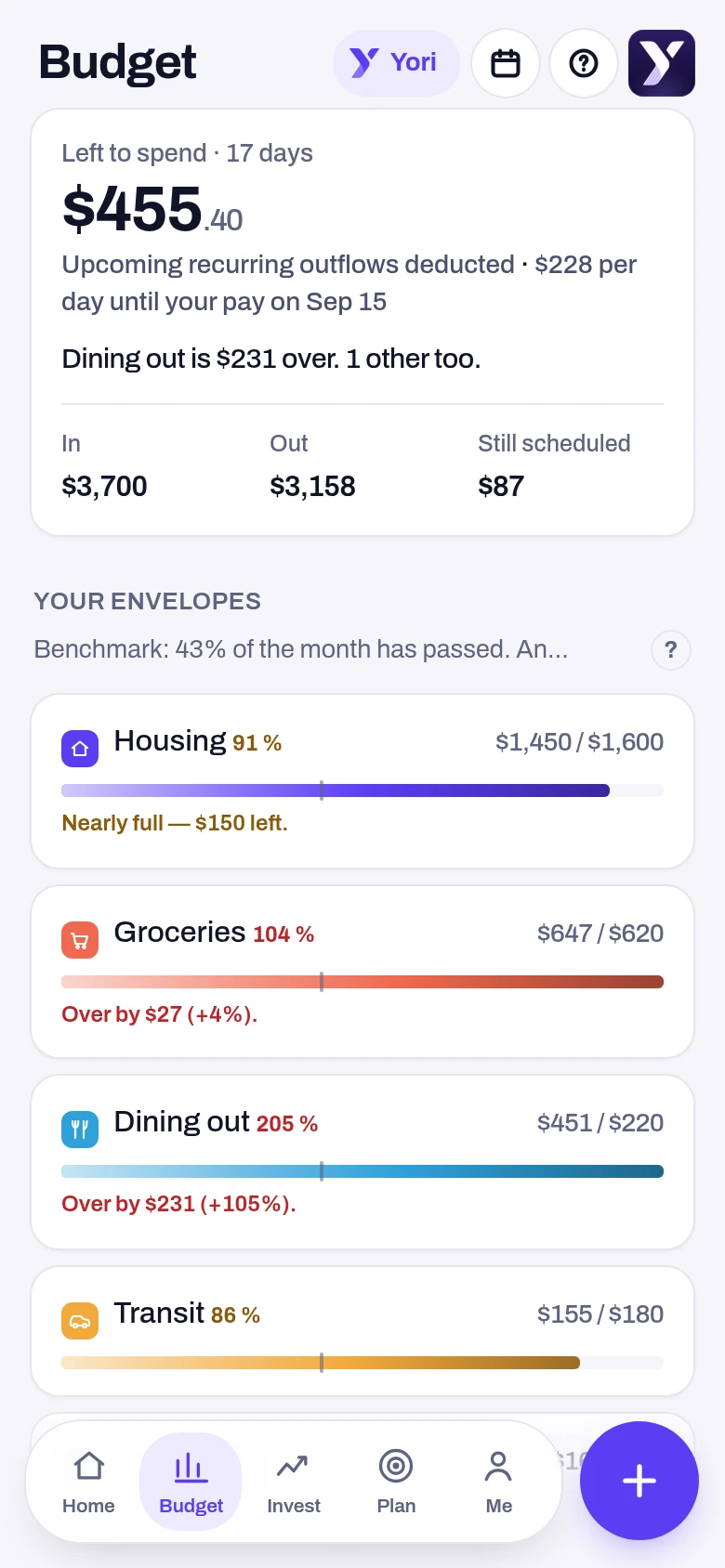
Seven envelopes. Not ten, not thirty.
Your caps add up to $2,750, or 63% of your $4,350 income. The rest goes to savings and to paying down debt.
ENVELOPES
7one locked: housingTOTAL CAP
2 750 $set by you, suggested by your historyINCOME
4 350 $received this monthCOVERAGE
63 %of income goes through an envelopeA cap is set on your median, not on your wish.
When you change a cap, Yoseri shows what you actually spent. Your groceries have a median of $512 over twelve months: a $600 cap leaves you 17% of room.
- Fixed, variable, recurring or catch-all: the type changes the calculation
- Housing locked: rent is not negotiated month to month
- Rename, recolour, reorder — without losing the history
All your envelopes
Total cap $2,750Fixed · locked
1 250 $Variable · median $512
600 $Variable
260 $Variable · median $214
220 $Variable · irregular by nature
120 $Recurring
100 $Catch-all · to be split up later
200 $Your twelve-month median is $512 for groceries. A $600 cap leaves you 17% of room.
Your restaurant spending rose 21% in a month — $219 in July, $265 in August — with a steady average ticket of $22. What changed is the frequency: twelve outings instead of ten.
Two moves that keep your envelopes honest.
A grocery bill rarely contains only groceries, and a category always ends up deserving its own line. Both are handled without breaking the history.
Splitting a transaction
Left to allocate $0.0086,40 $
Metro Plus · August 15 · three envelopes
Everyday food · 67%
−$58.20In-store pharmacy · 21%
−$18.20Household products · 12%
−$10.00Each share counts in its own envelope, but the transaction stays single on your bank statement. You can apply the change to this transaction alone, to the 12 past Metro Plus transactions, or to all future ones.
Creating an envelope
Suggested cap $4029 $ / month
Vet and pet shop · spotted over twelve months
Currently Other · 3 transactions
−$128.40Currently Health · 2 transactions
−$214.00Moving these five transactions recalculates your history: the averages for Health and Other correct themselves too. Nothing is lost, everything is reversible.
You already know the 28th will be tight.
Every recurrence, every due date and every expected inflow lands on the next fourteen days. From that Yoseri works out your low point of the month — $2,107, on the 28th — before it arrives, while you can still move something.
The low point is seen in advance, or it is useless.
An average balance says nothing useful. What matters is the day your account hits its minimum.
- Reminder three days before a direct debit — the only moment when acting costs nothing
- Money in and money out on the same grid, not two separate screens
- A recurrence with a variable amount asks you for the real figure, with no guessing
What is coming · next 14 days
Low point: $2,107 on the 28thAugust 22 · subscription
−$20.99August 26 · recurrence
−$842.00August 28 · due
−$1,240.60August 30 · savings rule triggered
+3 200,00 $September 1 · 4th Avenue
+1 150,00 $Projected balance on August 31: $5,728, with every scheduled outflow deducted and both inflows on the 30th counted.
revenus | What is left of your month, worked out to the dollar, before connecting a bank.
Free with manual entry, no banking credentials and no card. You see your first statement in four minutes.
A variable income is budgeted on its floor, not on its average.
Over twelve months you took in $59,248, or 6.2% more than the year before. That is $4,937 a month on average — but your floor is $3,350.
LAST TWELVE MONTHS
59 248 $+6.2% vs the year beforeMONTHLY AVERAGE
4 937 $four sources detectedFLOOR
3 350 $the budget’s real baseSAVINGS RATE · 12 MONTHS
21,8 %$12,916 of the $59,248 receivedFour sources, four different treatments.
Salary, self-employment, rent received, dividends: Yoseri detects your sources, their frequency and their regularity. A regular source counts for its full amount.
- Frequency, spread of amounts and treatment shown for every source
- Next inflow announced: on the 30th, net salary of $3,200, in six days
- Quarterly dividends are not counted as monthly income
Sources detected
$4,937 / month on averageRegular · every 30th
3 200 $Variable · 8 months out of 12 · floor $610
810 $Regular · every 1st
1 150 $Quarterly · next September 15
142 $The amber amount is a variable source: Yoseri keeps its floor, not its average.
Your 4th Avenue rent arrived late three months out of four. Your overdrafts on the 6th and 7th come from that, not from your spending.
The receipt is read on your phone. The image never leaves.
Photograph a receipt: merchant, date, total, taxes and line items are extracted on the device. No image is sent to a server, not even for the analysis.
One trip to the grocery store, three envelopes.
$86.40 at Metro Plus is rarely $86.40 of groceries. The scanner reads the lines — $58.20 of food, $18.20 of pharmacy, $10.00 of household — and splits the transaction without creating a second one.
- The receipt attaches to the existing transaction, never a duplicate
- Kept five years for warranties, attached to reimbursement claims
- Carried into the export if you deduct self-employment expenses
Receipt recognised
Metro Plus · August 15Taxes $4.20 · paid by debit
86,40 $Groceries envelope
58,20 $Health envelope
18,20 $Other envelope
10,00 $An $86.40 transaction already exists on August 15. The receipt attaches to it.
It stays on your phone.
The reading goes through no server.
Not for the analysis, not for improving the model.
Three minutes a week. Zero banking credentials.
The free mode is not a demo: it is the same budget, kept by hand. Thirty-four entries a month, of which 71% go through a template, in one tap.
Seven entries out of ten take one tap.
A template stores the amount, the envelope and the merchant. Eight templates cover 71% of your thirty-four monthly entries: the weekly grocery run at $60, the morning coffee at $7, the tank of petrol at $55, the transit pass at $97.
- A transaction can be split, excluded from the budget or turned into a recurrence
- Receipt photo kept on your device, never sent to a server
- Everything is reversible for 30 days: 184 actions can be undone right now
Quick entry
71% by templateTEMPLATES
8ENTRIES / MONTH
34BY TEMPLATE
71 %Metro Plus · Groceries
60,00 $Café Olimpico · Restaurants
7,00 $Esso · Transport
55,00 $Transport · monthly
97,00 $Health
24,00 $Income · every 30th
+3 200,00 $You entered “Pizzeria Napoli” four times this month for similar amounts. Make it a template?
RULES
14they sort 82% of your transactionsTRANSACTIONS PER MONTH
248sorted without interventionACCURACY
99,3 %five errors in 744 transactions over three monthsTO SORT
18out of 302 transactions this month- Suggest seven envelopes from your declared income$4,400 declared gives $2,730 of envelopes, $790 of savings, $880 free.
- Work out what is left this month from your first entry
- Build your calendar as soon as your recurrences are inAbout two minutes, once and for all.
- Your real averages — it takes three months of entriesUntil then, the caps are marked “estimated”.
- A useful finding before the third weekA pattern only becomes visible past a certain number of transactions.
- A year-on-year comparison before twelve months
What people ask us before starting.
The answers carry figures, and the limits are stated alongside the capabilities.
Why is what is left this month so far from my balance?
Because a balance does not know what is coming. Your chequing account shows $4,210.20, but $1,604 is still going out before the 31st: the mortgage on the 26th, the groceries and transport still to come, two subscriptions and the smoothed annual sinking fund.
Is my credit card payment counted twice?
No. The $1,240.60 on the 28th therefore does not appear in “still to go out”, even though it will indeed leave your account.
What happens if I go over an envelope?
Going over carries forward, and so does a surplus. Restaurants went $45 over last month: its September cap will be $175, not $220.
Does Yoseri know what I do with my cash?
No, and it says so. You allocate your cash in a few taps — $32 to groceries, $20 to transport — and the remaining $24 is shown as unallocated, never spread at random to look tidy.
Does it work without connecting my bank?
Yes, and it is free for life. Thirty-four entries a month, 71% of them in one tap thanks to templates, plus the recurrences that repeat on their own: about three minutes a week.
How long before Yoseri tells me something useful?
The budget and the envelopes exist from your first entry. The first finding arrives around the third week, when a pattern becomes visible, and year-on-year comparisons after twelve months.
Further reading on this.
Yoseri’s publication unpacks these mechanisms with the maths shown, using worked figures you can redo by hand.
An envelope budget without rollover is not a budget
If going over your envelope has no consequence the following month, the cap is only decoration. Rollover is what turns an intention into a constraint.
· 4 min The ShortVariable income: budget on your floor, never on your average
An income swinging between $380 and $1,840 has no useful average. Budgeting on it means spending a good month as though it were normal.
· 2 min The GlossaryEnvelope rollover
What is left — or what is missing — at the end of the month, carried into the next. The mechanism that separates a budget from a good intention.
· 1 minKeep looking around
Eleven digital services, $1,152 a year. Including a gym at $599 with no other transaction since March.
See the subscriptions Savings and goalsThe $800 rule triggered on every payday, $9,600 set aside this year, 16.2% of what came in over the last twelve months.
See savings Accounts and net worth$2,340 of internal transfers cancelled out this month, and never an amount shown as current when it is not.
See the accountsYour first budget, before connecting anything at all.
Four questions, then seven envelopes suggested from your declared income. They are marked as estimates, and they correct themselves as soon as you start entering.
Free with manual entry, for life. No banking credentials required. Read-only, always.